
Category: Business

  • Working Capital Loans for Small Business Owners Who Need Cash Before Customers Pay

    Working Capital Loans for Small Business Owners Who Need Cash Before Customers Pay

    Every April, a landscaping company owner in Ohio faces the same squeeze. Mowers need servicing, mulch has to be bought in bulk and five new seasonal workers start on payroll. The first big checks from commercial clients will not arrive until June. The business is healthy. The calendar is the problem.

    That gap between spending and getting paid is exactly what a working capital loan is built for. It is short term financing that covers everyday operating costs such as payroll, inventory, rent and supplies. It is not meant for buying a building or a decade of equipment. It keeps the lights on and the shelves stocked while revenue catches up.

    Signs You Might Actually Need One

    Borrowing for operations makes sense in a few specific situations:

    • Seasonal swings. Retailers before the holidays, landscapers in spring, tax preparers in January.
    • Slow paying customers. You invoice on net 30 or net 60 terms but pay your own suppliers sooner.
    • A large order or contract. You need to buy materials and hire help before the customer pays.
    • A supplier discount. Paying early or buying in bulk saves more than the cost of borrowing.
    • A short, predictable dip. Construction delays or a temporary loss of a key client.

    It is a weaker choice when the business is losing money every month. Borrowing to cover ongoing losses only delays a harder conversation.

    The Main Options Side by Side

    Working capital financing comes in many shapes. The right one depends on how fast you need money, how strong your credit is and how predictable your cash flow looks.

    Option Typical size Speed Cost level Best for
    Business line of credit $10,000 to $500,000+ Days to weeks Low to moderate Recurring, unpredictable gaps
    Short term bank loan $25,000 to $500,000 Weeks Low to moderate One known expense
    SBA 7(a) or SBA Express Up to $5 million (Express up to $500,000) Weeks to months Low Established businesses with good records
    SBA 7(a) Working Capital Pilot Lines of credit up to $5 million Weeks Low Manufacturers, contractors, order based businesses
    Invoice factoring or financing Based on unpaid invoices Days Moderate to high B2B firms with slow paying clients
    Inventory financing Based on stock value Weeks Moderate Retailers and wholesalers
    Merchant cash advance Based on card sales Hours to days Very high Emergencies only
    Business credit card Usually under $50,000 Immediate High if balance carried Small, short purchases

    The SBA Working Capital Pilot Deserves a Closer Look

    Many owners know the standard SBA 7(a) loan. Fewer know about its newer cousin, the 7(a) Working Capital Pilot, or WCP. It launched in August 2024 and offers monitored lines of credit inside the 7(a) program.

    It comes in two flavors. The asset based version lets a business borrow against receivables and inventory, often tracked through a borrowing base certificate. The transaction based version funds a specific order or project, covering costs before the job is finished or the product ships.

    Key features worth knowing:

    • SBA guarantees 85% of lines up to $150,000 and 75% of larger lines.
    • Lines can run up to $5 million with terms of up to 60 months.
    • Businesses generally need at least 12 months of operating history.
    • Not every SBA lender can offer it. Lenders need a specific WCP designation, so ask before applying.

    In February 2026, the SBA reported that WCP had produced more than $150 million in new lending since launch, driven largely by small manufacturers. In March 2026, the agency also highlighted project based lines of credit through the program for small homebuilders. If you build, manufacture or fulfill large contracts, it is worth asking your bank about it.

    The Expensive End of the Market

    Speed has a price. Merchant cash advances deserve special caution. Instead of an interest rate, they use a “factor rate,” such as 1.3. Borrow $50,000 and you repay $65,000, often through daily or weekly withdrawals from your card sales or bank account. Because repayment happens over a few months, the effective annual cost can be extremely high.

    Invoice factoring sits in the middle. A factoring company buys your unpaid invoices at a discount, advancing perhaps 80% to 90% of their value right away. It can be a reasonable tool for a B2B business with reliable clients who simply pay slowly, but the fees add up if invoices sit for 60 or 90 days.

    Always convert offers into an annual percentage rate before comparing them. A “small” weekly fee can hide a triple digit APR.

    What Lenders Look At

    Traditional lenders and the SBA generally review:

    • Time in business, often at least one to two years
    • Annual revenue and consistency of deposits
    • Personal and business credit scores
    • Cash flow, often measured as the debt service coverage ratio
    • Collateral such as receivables, inventory or equipment
    • Personal guarantees from owners holding a significant stake

    The SBA has also tightened some underwriting and eligibility rules in recent years, so it pays to ask a lender which current requirements apply before you gather documents.

    Online lenders tend to approve faster with looser requirements, often looking at a few months of bank statements. The trade off is almost always a higher cost.

    How to Prepare a Strong Application

    A little preparation can shave weeks off the process and lower your rate.

    1. Know your number. Calculate exactly how much you need and for how long, using a simple cash flow forecast.
    2. Clean up your books. Have recent profit and loss statements, a balance sheet and tax returns ready.
    3. Pull an accounts receivable aging report. Lenders want to see who owes you and how late they are.
    4. Explain the use of funds. “Buy holiday inventory that historically sells through by December” is far more convincing than “general expenses.”
    5. Apply before the crunch. A line of credit is easiest to get when you do not urgently need it.

    Using the Money Well

    The healthiest working capital loans pay for themselves. Inventory bought with borrowed funds should sell at a margin that covers the interest. Payroll covered during a slow month should be tied to revenue that is clearly on the way.

    Set a repayment plan before you draw a dollar. With a line of credit, aim to bring the balance back toward zero at least once a year. Many banks expect that “clean up” period, and it proves the line is funding timing gaps rather than a deeper problem.

    Back in Ohio, the landscaper who opens a modest credit line in winter and draws it only from April to June ends up paying a few hundred dollars in interest. The one who waits until payroll bounces ends up with a cash advance and a much bigger bill. The loan itself is the same idea. The timing and the type make all the difference.
  • Net Working Capital Shows How Much Breathing Room a Business Really Has

    Net Working Capital Shows How Much Breathing Room a Business Really Has

    Two coffee roasters can post the same annual profit and still live very different lives. One pays suppliers on time, restocks beans without stress and sleeps well. The other scrambles every month to cover payroll while waiting on wholesale customers. The difference usually is not profit. It is net working capital.

    Net working capital (NWC) is the money a business has available to run its daily operations after it covers the bills coming due in the near term. It is one of the simplest numbers on a balance sheet and one of the most revealing.

    The Formula

    The basic calculation is short:

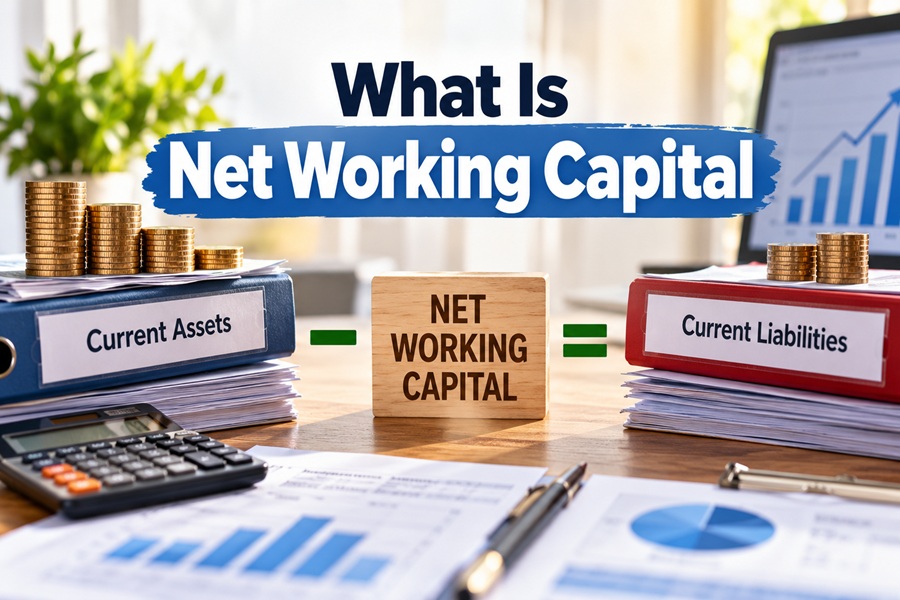
    Net working capital = Current assets minus Current liabilities

    “Current” means anything expected to turn into cash, or come due, within about one year.

    Current assets usually include:

    • Cash and cash equivalents
    • Accounts receivable, which is money customers owe you
    • Inventory
    • Prepaid expenses, such as insurance paid in advance
    • Short term investments

    Current liabilities usually include:

    • Accounts payable, which is money you owe suppliers
    • Accrued wages and taxes
    • Short term loans and lines of credit
    • The current portion of long term debt
    • Customer deposits or deferred revenue

    A Worked Example

    Imagine a small furniture maker with this snapshot at the end of the quarter.

    Current assets Amount Current liabilities Amount
    Cash $40,000 Accounts payable $35,000
    Accounts receivable $55,000 Accrued payroll $18,000
    Inventory $70,000 Line of credit balance $25,000
    Prepaid expenses $5,000 Current portion of equipment loan $12,000
    Total $170,000 Total $90,000

    Net working capital is $170,000 minus $90,000, or $80,000. If every short term obligation came due tomorrow, the business would have enough short term resources to cover them with $80,000 to spare.

    Positive, Negative and Zero

    Positive NWC means current assets are larger than current liabilities. That is generally a sign the business can meet its short term obligations and absorb surprises.

    Negative NWC means short term debts exceed short term resources. For most small businesses this is a warning sign. It can lead to late payments, strained supplier relationships and emergency borrowing.

    There is an important exception. Some companies run negative working capital on purpose and do just fine. Grocery chains and fast food restaurants collect cash from customers immediately but pay suppliers 30 or 60 days later. Subscription software companies collect a year of fees upfront. In those models, suppliers and customers are effectively financing operations, which is a strength rather than a weakness.

    Zero NWC is rare and leaves no margin for error.

    More Is Not Always Better

    It is tempting to think a giant positive number is ideal. It is not. Excess working capital can mean cash is sitting idle, inventory is piling up in a warehouse or customers are taking too long to pay. Money tied up in slow moving stock or stale invoices is money that is not earning anything.

    The goal is enough working capital to operate smoothly and handle a bad month, but not so much that it drags on returns.

    The Ratio Version

    Because a dollar figure on its own does not say much about scale, many people also look at the current ratio:

    Current ratio = Current assets divided by Current liabilities

    In the furniture example, $170,000 divided by $90,000 gives a ratio of about 1.89. Lenders often view a ratio between roughly 1.2 and 2.0 as healthy for many industries, though norms vary widely. A ratio below 1.0 means negative working capital.

    A stricter cousin is the quick ratio, which leaves inventory out of current assets. It answers a harder question: could the business pay its short term bills without selling a single product?

    Operating Working Capital Is the Number Analysts Watch

    Finance teams often strip cash and debt out of the calculation to see how efficient the core operation is. This version, sometimes called operating working capital or non cash working capital, looks only at receivables, inventory and payables.

    It matters most in two places:

    • Company valuations and acquisitions. Buyers and sellers usually agree on a “normal” level of working capital, called a peg. If the business has less than the peg at closing, the purchase price can be adjusted down.
    • Cash flow forecasting. When working capital grows, it absorbs cash. When it shrinks, it releases cash. That is why a fast growing company can be profitable and still run out of money.

    Why Growth Can Squeeze Working Capital

    Here is the counterintuitive part. Rapid sales growth often makes working capital tighter, not looser. A company landing big new orders must buy materials, pay staff and ship products long before customers pay their invoices. The more it sells on credit terms, the more cash gets locked in receivables.

    This timing gap is measured by the cash conversion cycle, which adds days of inventory and days of receivables, then subtracts days of payables. A shorter cycle means cash comes back faster and less working capital is needed to support each dollar of sales.

    Practical Ways to Improve It

    Businesses that want more breathing room usually work on all three levers at once.

    • Collect faster. Invoice immediately, offer small early payment discounts and follow up on overdue accounts every week.
    • Carry leaner inventory. Identify slow moving items, reorder based on actual demand and avoid bulk buys that sit for months.
    • Negotiate supplier terms. Moving from net 30 to net 45 on major purchases can free up meaningful cash.
    • Refinance short term debt. Converting a pricey short term loan into longer term financing reduces current liabilities.
    • Keep a cash buffer. Even a modest reserve smooths out seasonal swings.

    When those steps are not enough, many owners turn to a working capital line of credit to bridge timing gaps rather than fund losses.

    Reading the Number in Context

    Net working capital is a snapshot, so trends matter more than one reading. Compare it month to month and against peers in your industry. A restaurant and a construction firm will never look alike, and that is fine.

    For a business owner, the most useful question is not “is my number big?” but “does my number give me enough room to run the business without panic?” When the answer is yes, working capital is doing its job.