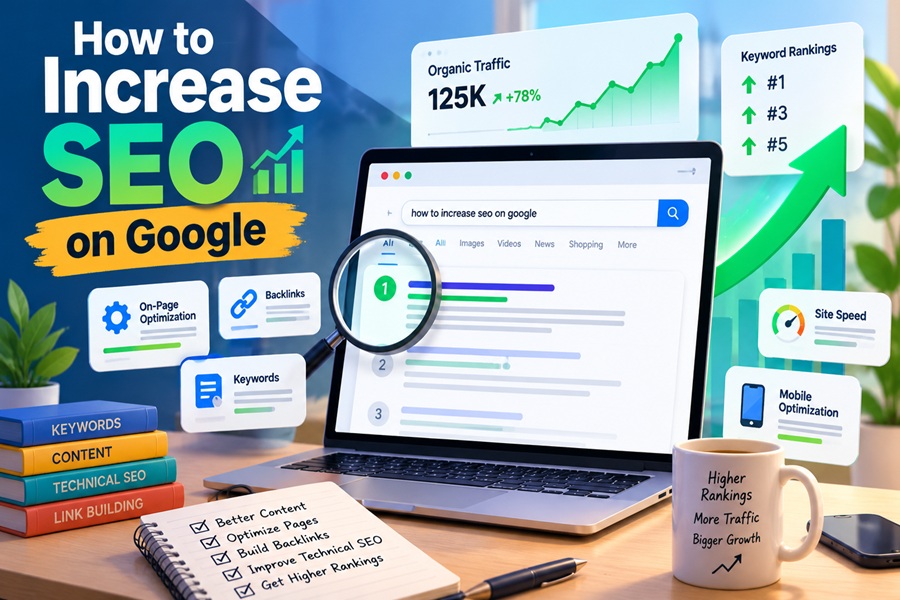
Type almost any informational question into Google today and the first thing you read is not a website. It is a summary. Below it sit the familiar blue links, and somewhere inside that summary sit a handful of cited sources. Increasing your SEO on Google now means competing for both spots at once: the ranked link and the citation.
The short answer is this. You increase SEO on Google by making pages that answer a searcher’s full problem better than anything else indexed, making sure Google can crawl and render them without friction, connecting them with clear internal links, and earning mentions and links from sites people already trust. None of that is new. What changed is how unforgiving Google has become toward pages that only repeat what already ranks.
What Google spent this year rewarding
Google ran two broad core updates in quick succession. The March core update rolled out from March 27 to April 8, just days after a spam update that finished in under 20 hours, the shortest one Google has ever logged on its status dashboard. The May core update followed on May 21 and was marked complete on June 2.
Google described both in the same plain words: a regular update meant to surface relevant, satisfying content from all types of sites. Industry trackers read the March update as one of the most volatile on record, and the sites hit hardest were often those that had already slipped in December and never changed course. The common thread in post update analysis was information gain. Rewritten, aggregated pages that add nothing new lost ground. Pages carrying original data, firsthand testing or a clearer explanation held or climbed.
Then came Google I/O in May. The search box was redesigned, AI Mode moved to Gemini 3.5 Flash as its default model, and Google said AI Mode had passed one billion monthly users while AI Overviews reached roughly 2.5 billion. A searcher can now ask a follow up straight from an AI Overview and land in a conversational AI Mode session with context carried over.
The traffic math behind this is sobering. Ahrefs reran its click study with December 2025 data and found that when an AI Overview appears, the top ranking page earns about 58% fewer clicks on average than it otherwise would. A year earlier the same study measured a 34.5% drop.
So the job is not only to rank. It is to rank, get cited, and give the people who do click a reason to stay.
Start where you are already close
The fastest gains rarely come from new content. They come from pages already sitting on page one or two that Google half believes in.
Open Search Console, go to the Performance report, and filter for queries where your average position sits between roughly 5 and 20. Sort by impressions. Those are your striking distance pages. For each one, read the top three results and the AI Overview for the main query, then ask an honest question: what does a searcher still need after reading my page?
Usually the answer is one of a few things. The page answers the headline question but skips the obvious next one. It buries the actual answer under four paragraphs of warmup. It has no example, number, photo or comparison that proves the writer has done the thing. Fixing those gaps on ten existing pages will often move more traffic than publishing thirty new ones.
Levers ranked by how fast they tend to pay back
Not every SEO task deserves the same urgency. This is roughly how they sort in practice.
| Lever | Typical time to see movement | Why it matters now |
|---|---|---|
| Rewriting titles and opening answers on striking distance pages | 2 to 6 weeks | Better match to intent, cleaner extraction for AI summaries |
| Fixing indexing errors and blocked resources | 1 to 4 weeks after recrawl | Pages Google cannot index cannot rank or be cited |
| Internal links from strong pages to weak ones | 3 to 8 weeks | Redistributes authority you already own |
| Improving Core Web Vitals field data | 1 to 3 months | Tiebreaker signal and a real conversion factor |
| Publishing original research or firsthand guides | 2 to 6 months | The clearest form of information gain |
| Earning links and brand mentions | 3 to 12 months | Trust signals for rankings and for which brands AI features surface |
Write the answer first, then earn the rest of the page
AI Overviews and AI Mode pull passages that can stand on their own. Google’s own Search Central guidance says there is no special markup for AI features. Pages simply need to be indexed and eligible to show a snippet, and normal SEO fundamentals apply.
In practice, the pages that get pulled into summaries share a habit. Each section opens with a direct, complete sentence that answers the heading, and then the section expands with detail, caveats and examples. A reader skimming gets the answer. A reader staying gets depth. A language model extracting gets a clean passage.
Query length matters here too. Google reported that AI Mode queries run about three times longer than classic searches, and that planning style queries grew 80% faster than AI Mode overall. People now type “best way to fix a slow WordPress site on shared hosting without a developer” instead of “slow WordPress.” Your headings and examples should reflect the longer, situational way people actually ask.
Show the work behind the words
Google’s quality rater guidelines lean on experience, expertise, authoritativeness and trust. Raters do not rank pages, but the systems are tuned to agree with them, and core updates keep pushing in that direction.
You show experience with evidence, not adjectives. That means:
- Screenshots, photos or data from your own testing
- Named authors with a real bio and a track record on the topic
- Specific numbers, dates, prices and conditions instead of vague claims
- Honest limitations, such as when your advice does not apply
- Clear sourcing when you lean on someone else’s research
A page that says “we tested five caching plugins on the same server and here are the load times” will beat a page that says “caching plugins can improve speed” nearly every time now.
Keep the technical floor solid
Technical SEO rarely wins rankings alone, but it quietly caps everything else. Check these in Search Console and a crawler such as Screaming Frog:
- Every page you want found is indexable, canonical to itself, and included in your XML sitemap.
- Important content and links appear in the raw HTML, not only after JavaScript runs. Many AI retrieval crawlers execute little JavaScript at all.
- Your robots.txt blocks nothing you need, including the CSS and JS files Google uses to render pages.
- Interaction to Next Paint sits under 200 milliseconds in field data, alongside Largest Contentful Paint under 2.5 seconds and Cumulative Layout Shift under 0.1.
- Redirect chains, broken internal links and soft 404s are cleaned up after every site change.
Links still count, and mentions count more than before
Backlinks remain one of Google’s strongest signals of trust. The quality bar keeps rising though. A single link from a respected publication in your field outweighs dozens of links from generic guest post farms, and the spam updates keep targeting the latter.
What changed is the role of unlinked brand mentions. AI Mode tends to favor brands it has seen referenced repeatedly in trusted places: industry press, expert roundups, podcasts, review platforms, Reddit threads, directories. When someone asks AI Mode for the best option in your category, it is drawing on that web of mentions. Digital PR, original data that journalists want to cite, and genuine participation in communities where your customers talk all feed both rankings and AI visibility.
Measure the new way, not the old way
If you only watch organic sessions, you will misread what is happening. Impressions can climb while clicks fall, simply because more searches end inside an AI summary.
Track impressions and average position in Search Console alongside clicks. Set up a referral segment in GA4 for AI sources such as chatgpt.com, perplexity.ai and gemini.google.com. Watch branded search volume, because rising brand searches often mean your AI citations are working even when the click never happened on that first query. And after any core update, wait at least a full week after Google marks it complete before you judge the damage. Google itself recommends that pause, and acting on half rolled out data is how sites make bad decisions.
The work that keeps compounding
Every tactic above points at the same habit: publish fewer pages, make each one the most useful result for its query, and keep earning proof that real people trust you. Google keeps changing the shape of the results page. It has not changed what it is trying to find. A site built around genuine answers, clean access for crawlers and a reputation outside its own domain tends to come through each update stronger than it went in, and that is the most reliable way to increase SEO on Google over any stretch of time longer than a quarter.