
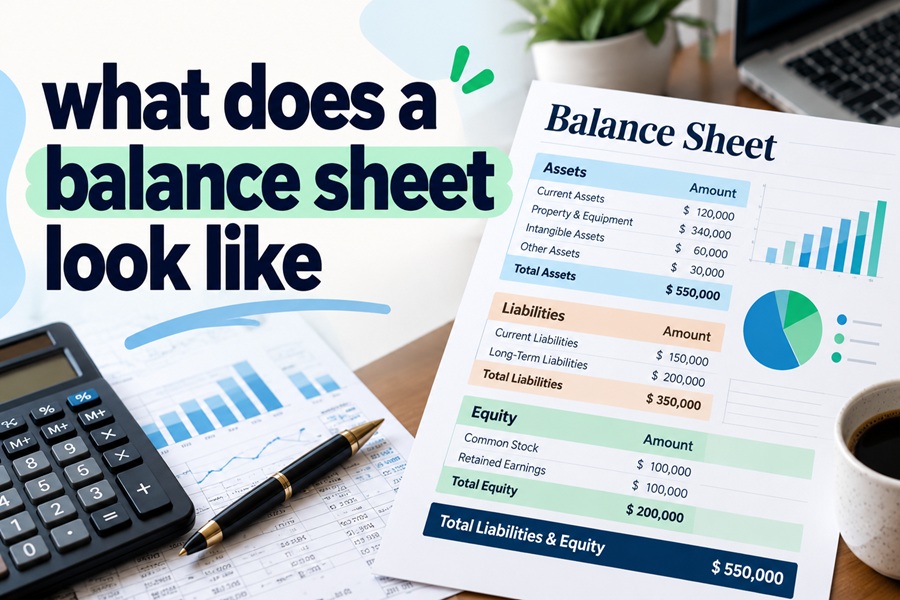
A profit and loss report is a video. It shows motion over a stretch of time, sales coming in and costs going out. A balance sheet is a photograph. It freezes one single day and shows what the business owns, what it owes, and what is left over for the owners.
That one idea explains most of the layout. Once you see the page as a snapshot, the lines stop feeling like random accounting vocabulary and start reading like an inventory of a company’s life.
The shape of the page
Every balance sheet, from a corner shop to a listed giant, rests on one equation:
Assets = Liabilities + Owner’s Equity
The left side of that equation is everything the business controls that has value. The right side explains where the money for those things came from, either borrowed from others or contributed and earned by the owners. Because both sides describe the same pile of resources, they must match. When a balance sheet does not balance, something is wrong with the records.
You will see the page arranged in two common ways. In the report form, assets sit on top and liabilities and equity sit underneath, stacked in one column. In the account form, assets sit on the left and liabilities plus equity sit on the right, side by side. The content is identical. Only the layout changes.
A small example you can actually follow
Imagine a neighbourhood bakery called Rise and Grind. Here is its balance sheet on 31 December.
| Rise and Grind Bakery | Amount |
|---|---|
| ASSETS | |
| Cash at bank | 18,000 |
| Accounts receivable | 4,500 |
| Inventory (flour, packaging, ingredients) | 3,500 |
| Prepaid insurance | 1,000 |
| Total current assets | 27,000 |
| Ovens and equipment (net of depreciation) | 40,000 |
| Delivery van (net of depreciation) | 23,000 |
| Total non current assets | 63,000 |
| TOTAL ASSETS | 90,000 |
| LIABILITIES | |
| Accounts payable | 6,000 |
| Wages owed | 2,500 |
| Sales tax payable | 1,500 |
| Short term loan instalments due this year | 5,000 |
| Total current liabilities | 15,000 |
| Long term bank loan | 30,000 |
| TOTAL LIABILITIES | 45,000 |
| OWNER’S EQUITY | |
| Capital contributed | 25,000 |
| Retained earnings | 20,000 |
| TOTAL EQUITY | 45,000 |
| TOTAL LIABILITIES AND EQUITY | 90,000 |
Both totals land on 90,000. That match is the whole point.
Walking through the sections
Current assets
These are things the bakery expects to turn into cash, or use up, within about a year. They are listed in order of liquidity, meaning how quickly they become cash. Cash comes first, then money customers owe (receivables), then stock on the shelves, then prepayments such as insurance paid ahead of time.
Non current assets
These are the long haul items, the ovens and the van. They are shown after subtracting accumulated depreciation, which spreads their cost across the years they will be useful. That is why a van bought for 30,000 might appear at 23,000. Larger companies add lines here for property, intangible assets such as patents or software, and goodwill from acquisitions.
Current liabilities
Bills and obligations due within a year. Suppliers waiting to be paid, wages earned but not yet paid out, taxes collected but not yet sent to the authorities, and the part of a loan that falls due soon.
Non current liabilities
Debts that stretch beyond a year, such as a long term bank loan, bonds, or lease obligations. Splitting current from non current matters because it shows whether the business can cover near term bills with near term resources.
Equity
What remains for the owners. Capital contributed is the money they put in. Retained earnings is the profit the business has kept over its life instead of paying out. For a corporation you will also see share capital, additional paid in capital, and sometimes treasury stock or other comprehensive income.
Reading it like an analyst in five minutes
A balance sheet becomes useful when you ask it questions. A few quick checks reveal a lot.
- Can the business pay its short term bills? Divide current assets by current liabilities. In the bakery that is 27,000 divided by 15,000, or 1.8. A figure comfortably above 1 suggests breathing room.
- How much is borrowed? Compare total liabilities to equity. The bakery sits at 1 to 1, meaning half of everything is funded by lenders.
- What is the cash cushion? 18,000 in cash against 15,000 in current liabilities is a healthy position for a bakery with steady daily sales.
- Is working capital positive? Current assets minus current liabilities gives 12,000 here, the day to day fuel the business runs on.
- What is hiding in the receivables? If the receivables figure keeps growing faster than sales, customers may be paying slowly.
Things the balance sheet will not tell you
The page is honest but limited. It records most assets at historical cost less depreciation, so a building bought decades ago may sit on the books far below its market value. Brand strength, a loyal customer list and a talented team usually do not appear at all unless they were purchased. And because it is a single day, a business can look healthy on 31 December and strained in February. That is why analysts compare several periods side by side and read the balance sheet together with the income statement and cash flow statement.
Common formats you may run into
- Classified balance sheet: The standard layout with current and non current groupings, shown above.
- Comparative balance sheet: Two or more year end columns next to each other, so you can see change.
- Common size balance sheet: Every line shown as a percentage of total assets, handy for comparing companies of different sizes.
- Consolidated balance sheet: A parent company combined with its subsidiaries into one picture.
Companies reporting under international standards sometimes flip the order, listing non current items first or presenting net assets as a single figure. The meaning stays the same.
A few mistakes worth avoiding
People new to the page often mix up its roles. Revenue and expenses do not appear on a balance sheet directly, because they belong to the income statement, though their net result flows into retained earnings. Owner withdrawals reduce equity, they are not an expense. And a loan received is not income, it is a liability that arrived with matching cash.
If your numbers will not balance, start by checking that every transaction was recorded on both sides, that depreciation was posted, and that the opening balances match last period’s closing figures. A single transposed digit can throw the whole page off by an amount divisible by nine, which is a classic clue.
The takeaway
A balance sheet is a one day portrait with three characters in it: what the business has, what it owes, and what belongs to the owners. Learn to spot those three, check that the sides match, and run two or three quick ratios. That is enough to tell whether the picture looks calm, stretched or quietly improving, and it is a skill that pays off whether you run a bakery, invest in shares or just want to understand the company you work for.